Into Your Work
I’m someone who defaults to intellectualizing my emotions. I can describe my feelings to you in perfect detail, but it’s not always as easy for me to actually feel them. And for a long time, I didn’t actually realize there is a difference between the two!
Eventually, and fortunately, I had the opportunity to go to therapy for the first time. And through that, I realized that I wanted (and needed!) to feel my emotions – even if it felt strange. At first, it felt totally impossible. But luckily, I found that doing something physical with my body, like baking, can actually help me process emotion.
Baking by Feel
Through the baking process, you’re creating in physical space and doing something tactile to engage with the senses. And here’s so much sensory stuff going on – you’re smelling, seeing, and obviously the big one – tasting. This element of grounding into the here-and-now physical reality helps us to get out of our own way, and out of our own head. The idea works with any number of activities – playing music, crafting, caring for plants. Anything mood-boosting and tactile! But I’m a baker, and the logical thing for me was to use baking.
Using cooking/baking as a tool for emotional processing is quite common. We saw this at the beginning of the COVID-19 pandemic when people began experimenting with sourdough starters and making their own bread. Many of us find ourselves whipping up something delicious when we’ve had a bad day. It encourages us to carve out space for ourselves and our emotions so we’re better able to navigate our often messy and complicated lives. So I see my cookbook, Baking by Feel, as a guidebook for doing this useful practice that many people already do.
Emotion Driven Cookbook
Baking by Feel is a choose-your-own-adventure cookbook. Each recipe has a paired emotion – for example, the Orange Creamsicle Cake is paired with “silly”. You choose what to bake based on whatever emotion you happen to be feeling. I organized the book into 5 chapters: happy, sad, mad, anxious, hopeful, and within those chapters there are more specific emotions that are each paired with a recipe. I know you might be wondering how the recipe pairings work. I came up with them in a few ways!
It could be about the complexity of the recipe
My Brown Butter Caramel recipe is paired with panicked because it’s such a precise process – you have to be fully dialed into the current moment. I’m inviting you to focus on the sensory experience in front of you. For example, you must boil the caramel to exactly 248 degrees. This focus takes away the power of the panic by redirecting you away from thoughts about the future or the past (or whatever is triggering that feeling of panic), and onto making sure your caramel doesn’t burn.
It could be about some part of the process
The emotion pairing for my Black Pepper Snowballs is vengeful. In the recipe, we’re really getting in there and mixing and smashing the dough – entirely by hand. So you’re channeling your vengefulness into physically working with the dough.
Or just by the vibe
For homesick, we’re making delicious, rainbow sugar encrusted Sour Cream Sugar Cookies that taste exactly the same at every mall in the US. For delighted, we’re making a lemon cake because lemon is just such a bright and happy flavor.
One of the core themes in the book is that there are no good or bad feelings, there are just feelings. It’s very easy to categorize emotions as being either good or bad, positive or negative, productive or unproductive. Something that was really important to me when I was writing Baking by Feel was emotionally agnostic – meaning you’re not going to find any judgment in the book about any feelings, even if they’re sometimes demonized elsewhere (for example, feeling selfish).
We don’t need to judge ourselves for any of the emotions we experience! And I’d go even further and say when we’re categorizing some emotions as “bad” and judging ourselves for experiencing them, we’re actually sort of holding them at arm’s length and preventing ourselves from feeling them.
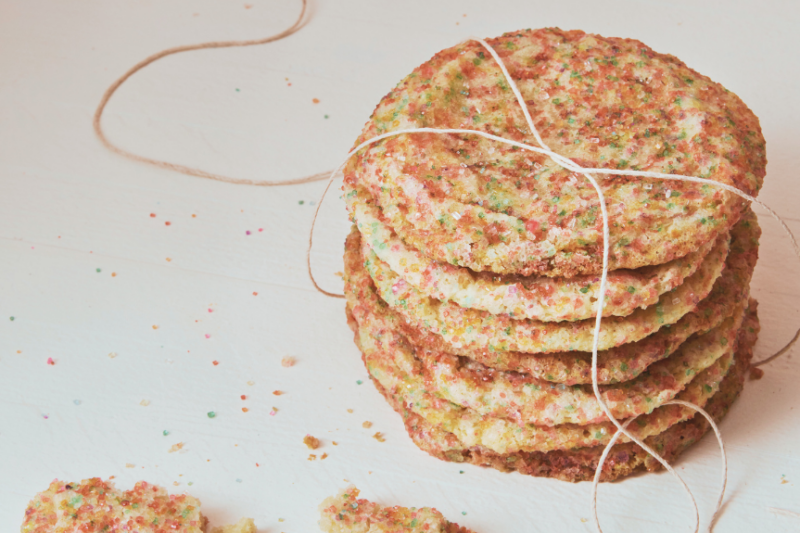
Sad Sour Cream Sugar Cookie
Learning to Bake
I learned to bake from my grandma Jane. There was always a delicious smell when I would go over to her house – and several of the recipes in Baking by Feel (the butterscotch pie, the chocolate chip cookies) are in homage to the things she used to bake. As a teenager, I baked a lot of cakes from boxed mixes. As someone in my early 20s, I started a food blog with my roommate. That’s when I really started learning how to develop recipes. I figured out I really liked playing with flavor – it’s such a creative process, and it was always a great outlet for me.
I love baking, and I love helping other people learn how to bake. So, unsurprisingly, writing a cookbook has been one of my dreams for a really long time. I wanted to combine a couple of my interests: the exploration of feelings + my love of baking. I firmly believe you don’t have to choose just one lane to stay in – I’m really proud to feature my abortion story in my cookbook (I think it may be the first time that’s happened!).
Creating During Tough Times
Of course, it wasn’t always a smooth road! I started working on this book in a pretty tough, confusing, early-pandemic time. I had just been laid off from my job, and it felt a lot like the rug being pulled out from under me, and I also felt a lot of shame. It was scary, I felt lost and was just trying to figure out what to do. So, while I applied for literally hundreds of jobs, I was writing recipes and starting to try to figure out how to get a cookbook published. Which it turns out is a really complicated process involving a lot of rejection! Eventually, I found an editor who believed in my vision, but my manuscript helped me bake my way through it.
My hope is that Baking by Feel can be a tool in your emotional toolbox, ready on the shelf for whenever you need a boost of encouragement or a place to work through big, overwhelming feelings.